
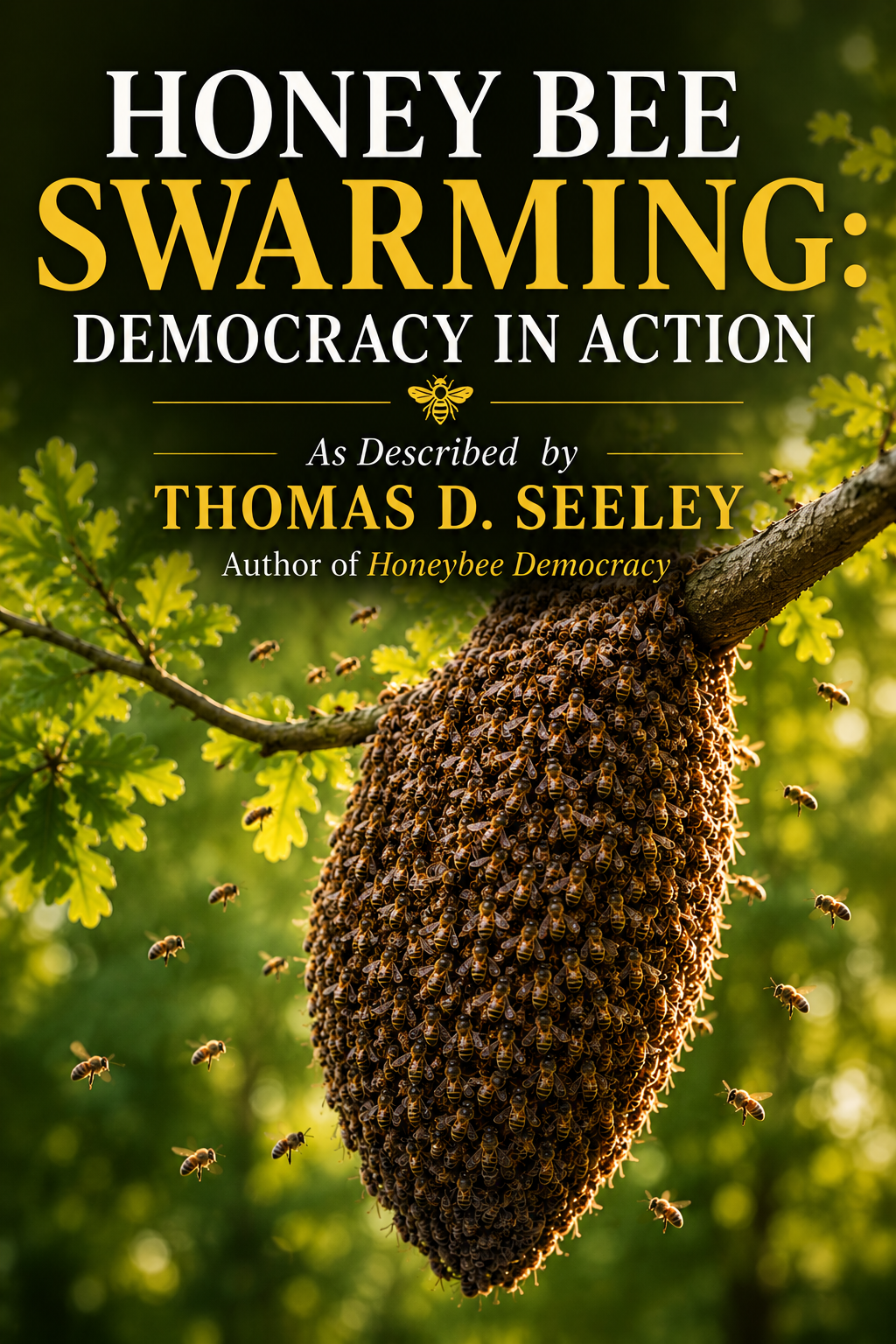
Honey Bee Swarming: Democracy in Action
One of the most fascinating events in beekeeping is witnessing a honey bee swarm. To many people, a swarm appears chaotic—a cloud of thousands of bees filling the air before settling into a cluster on a tree limb or fence post. In reality, swarming is one of nature’s most organized and remarkable examples of collective decision-making.
Much of what we know about this process comes from the pioneering work of Thomas D. Seeley, professor of biology at Cornell University and author of Honeybee Democracy. Through decades of research, Seeley revealed that honey bee swarms make decisions in a way that resembles a democratic process, with no single bee directing the outcome.
What Is Swarming?
Swarming is how a honey bee colony reproduces. When a colony becomes large and crowded during the spring nectar flow, the old queen leaves the hive with approximately half of the worker bees. The remaining bees stay behind to raise a new queen and continue the original colony.
Before departing, the swarm temporarily clusters nearby while scout bees search for a permanent home. During this time, the swarm may hang from a tree branch, shrub, or other structure for several hours or even several days.
The Search for a New Home
According to Seeley’s research, scout bees play a critical role in finding a suitable nesting site. These experienced foragers leave the swarm cluster and search the surrounding area for potential homes.
Scout bees evaluate locations based on several factors, including:
Internal cavity volume
Entrance size
Entrance orientation
Height above the ground
Protection from weather and predators
A hollow tree cavity is often considered an ideal natural nesting site.
When a scout discovers a promising location, she returns to the swarm and performs a waggle dance. The dance communicates both the direction and distance of the site to other scout bees.
Democracy Among Bees
What makes the process remarkable is that no bee is in charge.
Multiple scout bees may discover different potential homes and return to advertise them through waggle dances. The better a site appears, the more enthusiastically a scout bee dances for it.
Other scouts then visit the advertised locations and conduct their own evaluations. If they agree with the original assessment, they return and begin dancing for the same site. If not, they may support another location.
Over time, support grows for the most desirable nesting site. Through this process of independent evaluation and recruitment, the swarm gradually reaches a consensus.
Seeley’s research showed that swarms typically make excellent decisions because many individual bees contribute information before a final choice is made.
Reaching a Quorum
Rather than requiring every bee to agree, honey bee swarms use what researchers call a quorum.
When enough scout bees gather at one location and indicate their approval, the swarm effectively reaches a decision. Once this threshold is met, scout bees signal the clustered swarm that it is time to depart.
Thousands of bees then take flight together and travel to their new home, guided by scouts that know the destination.
Lessons from the Hive
One reason Honeybee Democracy has attracted attention beyond the beekeeping community is that the principles observed in honey bee swarms apply to many forms of decision-making.
The swarm succeeds because:
Many individuals gather information independently.
Multiple options are considered.
Decisions are based on evidence rather than authority.
Consensus develops through communication and evaluation.
No single individual controls the process.
These principles have inspired research in fields ranging from business leadership to robotics and artificial intelligence.
What Beekeepers Can Learn
Understanding swarm behavior helps beekeepers appreciate that swarming is not a sign of failure. It is a natural and healthy part of honey bee biology.
While beekeepers often manage colonies to reduce swarming and maintain honey production, witnessing a swarm reminds us of the incredible instincts and organizational abilities of honey bees.
The next time you see a cluster of bees hanging from a tree limb, remember that you are observing thousands of individuals participating in one of nature’s most sophisticated democratic processes.
Credit
This article is based on concepts and research presented by Thomas D. Seeley in his book Honeybee Democracy. Dr. Seeley’s work has greatly expanded our understanding of honey bee behavior, swarm intelligence, and collective decision-making.
Useful Links
Here are some other topics to help you along your beekeeping journey.